

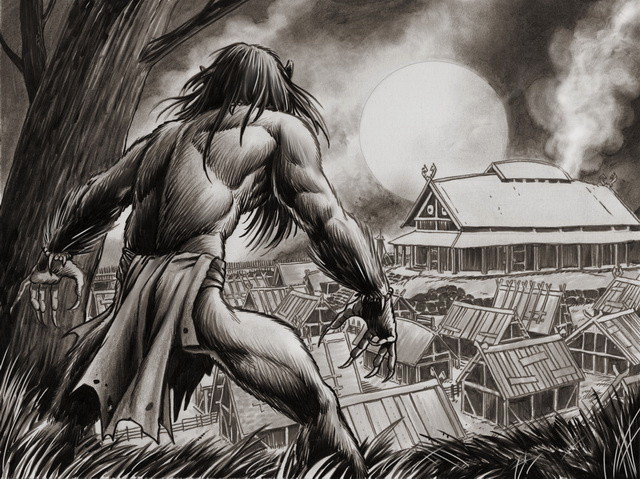
Written by John Gardner and published in 1971, Grendel is a takeoff on the epic Beowulf, told from Grendel’s perspective. In Beowulf, Grendel is portrayed as a tall, ugly monster that eats people in King Hrothgar’s kingdom, Heorot. Beowulf is the hero, while Grendel is the anti-hero.
Grendel is portrayed in two radically different ways in the novels Grendel and Beowulf. What accounts for most of the differences in the portrayal of a monster in both novels comes from two completely different perspectives.
The main thing that separates Grendel in both novels is the fact that readers are exposed to the humane side of Grendel. Readers are also shown a Grendel who thinks and has a sense of reason, while in Beowulf, they are shown only a brute with no thought beyond the next meal and its juiciness. There is much more that Grendel readers can discover if they just dig deep into his mind and pick out different details about how he is portrayed.
One of the main differences in the novels is the relationship between Grendel and his mother. There is a lot of detail that goes into explaining the rather complicated and intricate relationship they have. In Beowulf, there is no real description or account of any interaction between the two aside from Grendel’s mother’s attempt to avenge her son’s death. But then, Beowulf wasn’t about Grendel. In Grendel, however, readers learn that a close relationship exists between the two, especially as Grendel grows up. As he grows, his mother is the only companion readers are aware of. Grendel is not shown to have had any friends aside from his mother. The only flaw in their relationship is that they cannot communicate. Somehow, his mother has forgotten how to speak. Even with this setback, the bond between the two is still very strong, and they find ways to communicate. An example of this is when Grendel’s mother holds Grendel, and he rests his head against her chest to comfort him after his first encounter with the humans.
While Grendel is portrayed mainly as a physical creature in the original Beowulf, in Grendel, readers are given a glimpse of what his world is really like. Grendel lives in isolation and loneliness with his mother, who, in her old age, is unable to provide any real companionship to her child. As the only being of his kind, he has no one to relate to and feels the need to be understood or have some connection.
Grendel has a complex relationship with the humans who hate and fear him. He feels that he is somehow related to humanity, and despite his desire to eat them, he can be moved by them and their works. His long life grants him the ability to witness how their lives unfold, and their behavior and logic bewilder him. He is cursed to a life of solitude and is portrayed as having eternal life, which further deepens his loneliness, as he can only fall in battle and is immune to all human weapons. He is only freed from his tormented life through his encounter with Beowulf. The depressing side of Grendel’s story is not shown in Beowulf. Readers tend to read the epic without any idea of the harshness and struggles of life he endures every single day.
Symphony can be felt for Grendel in Gardner’s Grendel, but not really in Beowulf. It can be argued that he has a very teenage-like personality, whereas in Beowulf, he is portrayed as having no personality at all.
In Grendel, Grendel is very curious and impulsive, and he has no idea what he is meant to do. However, when he sees the Dragon, it identifies him as an oppositional force to Hrothgar and humanity, but also a force that pushes humanity towards progress. The Dragon’s main message to Grendel in Grendel is that Grendel knows who he is and what he is meant to do, so he has to follow through with who he really is. Grendel, according to the Dragon, is meant to kill and eat Hrothgar’s people.
Desperate to prove himself, Grendel follows through with his request and targets Heorot. In the epic Beowulf, though, he is more adult-like. He already knows what he wants to do, so he just attacks out of brute force. Nevertheless, this side of the monster leaves readers wondering what influenced him to kill and eat Hrothgar’s people. Was it his mother? Was it something else? What was it? Answers to all the questions are revealed in Grendel when Grendel’s true nature is revealed. At the end of the day, he is just another living being that wants to know his place in the world. He feels invincible, as portrayed in Beowulf, but in Grendel, readers learn that he is not.
Grendel in Beowulf is nothing like Grendel in Grendel. For example, when he first sees Beowulf, he is fascinated by him. He notices that he is built differently, with great muscles, and has a bit of an arrogant attitude. While he is fascinated by him, Grendel is also frightened. He understands that he can withstand any human weapon, but can he withstand Beowulf, the strong man the Danes called to kill him? Originally, before Beowulf came, Hrothgar’s people were weaker, which meant that it was easier for Grendel to attack them, but with Beowulf on set, he wasn’t sure if he could put up a good fight. Sure enough, during the battle with the hero, he lost his arm and died due to blood loss.
Grendel is, overall, a monster with multiple personalities. While he is the anti-hero, he is both a monster of Hell and a monster of Heaven. Just like people, he suffers from tragedy, emotions, and death. He is nothing, like what the writer of Beowulf tried to portray him as. He has a family, and he will do anything in his power to protect and save his mother from evil humans.
Grendel is a victim of racism, and he knows he is. Heorot’s people treat him like a monster, which he is, but they never try to delve into his head to understand his struggles. Since Grendel is different, they do not accept him into the chain of Danes; they just leave him to live in isolation.
ns216.73.216.75da2


 and then Add to home screen.